Friday, December 9, 2011

Martin

When I was five, I got a direct call from the big man himself one December evening asking me what I wanted for Christmas. I could barely speak when I heard the big, booming voice Ho-Ho-Ho-ing on the other end of the line, speaking through the crackle of a long-distance phone call. But I did manage to tell him that I wanted a doll house. And when he told me to be very, very good, I blushed. Because I had not been so very, very good that fall, and I hadn't heeded my mother's warnings about Santa and lumps of coal. But to hear it from the Claus himself...well, I vowed to clean up my act.

I was the designated household phone answerer in those days. My mother was quite popular, and the phone rang a lot. I was a call screener back before caller I.D. The ritual went like this: the phone would ring, and my mother would give me a set of conditions: if it was this person, Mom would take the call. But if it were that person, I was to say Mom was in the tub and would call her back sometime that decade. And if it were Granny, my dad's mom, I was to make polite small talk for long enough for Mom to light a cigarette and gird her loins for what would likely be an unpleasant conversation filled with veiled insults.

When the phone rang that December night and Santa was on the other end, my mom listened intently and had a strange look on her face when I mouthed "It's Santa!" It turns out she had not planned this particular bit of holiday joy, and until my cousin called her a few moments later to tell her it was my uncle's idea to surprise me, she couldn't figure out whether everything she thought she knew about Christmas legend was wrong and the magic was real, or if maybe I was being stalked and the next call should be to the police.

So a few weeks later when I took another call from a mysterious man I'd never met but had heard about, my parents didn't think too much about it. They thought it was just my uncle again, following up and making sure my behavior had improved. Imagine their surprise when they found out that I had just been formally introduced to my long-lost paternal grandfather.

My father covered the distance between the family room and the kitchen in two steps when I held out the phone and said, "He says his name is Martin and that he's your dad." Mom developed an unusual need throughout the duration of the phone call to keep checking on the cleanliness of the kitchen counters.

Martin left my grandmother, and the four children he had with her, when my father was very young. My father had not seen or talked to the man since he was about the age I was when I took that call. He had heard his father had relocated to the Cincinnati area, like us, and had heard he was living with a woman decidedly not our Granny. Beyond that, we didn't even have a picture of him, and he was the "He Who Shall Not Be Named" of our family. So to get that call was like something I had seen on one of my favorite soap operas. It was Guiding Light right there in our cigarette-smoke-filled kitchen. My young head filled to bursting with daydreams of a family reunion, and meeting a grandfather I didn't know I had, and a warm, fuzzy reconciliation.

But even at Christmas, broken families don't knit back together so tidily. My father never raised his voice, but he politely declined an invitation to meet him. He did, however, agree to have occasional phone conversations with Martin. I was sad that I wouldn't get to see the person who had been so nice to me over the phone, but as small children do, I forgot about it and went on with celebrating the toy-getting season.

The next time I heard anything about Martin, it was the following October. He had passed away from cancer. We did not attend the funeral. I didn't understand it then; why wouldn't Dad want to say goodbye to his own father? But as I grew older, I understood completely. My father had said goodbye many, many years before.

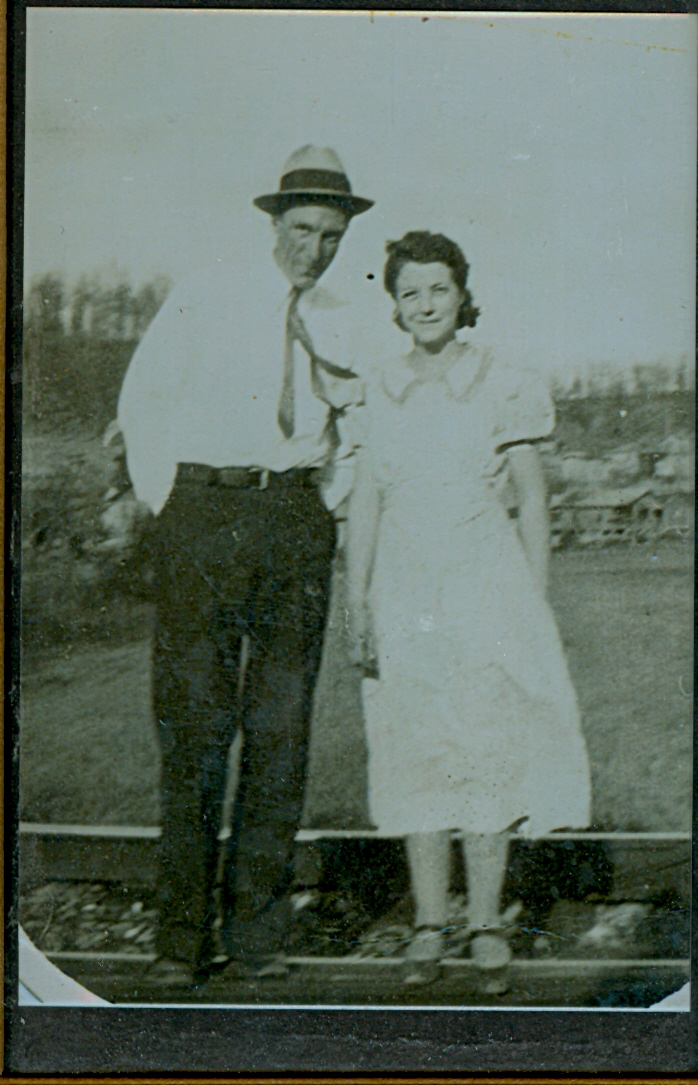
Several years ago, Dad's sister-in-law passed along a photo to me. One of her sons had become interested in learning more about the family, and had unearthed the only known photo of my enigmatic grandfather. It was an old black-and-white picture of a very tall, thin man and a very short, dark-haired woman standing together on a set of railroad tracks. The man is so tall that he has to stoop a bit to be in the same frame as his wife; the woman is so short she has to stand on one of the railroad ties to come up to her husband's shoulder. They look happy, but I know by the way their story ends that their height was not the only major difference they had.

The picture allows me to put a face with the voice I heard on the phone so long ago, a kind voice that seemed, to my naive ears, to want to make things right. But for my father, anyway, it was too little, too late. If my surprise phone call from Santa that year nearly turned my mom into a believer, the surprise phone call from Martin brought us all back down to earth. Not everything can be tidied up into a Hallmark-movie ending.

I may never have met my grandfather. But I got to speak to him, and the memory looms as large as the phone call I got from Santa at the North Pole (complete with reindeer "barking" in the background.) And if you're as big as Santa in a kindergartner's imagination...well, that's saying something.

Worth a Thousand Words

I have hit the jackpot.

I recently borrowed my mother's family photo albums so that I can make copies of some of the pictures of myself as a child to keep in an album for Ainsley. The reasoning behind this is morbid, but simple: in the event something happens to me, I want it to be easy for my survivors to put together photos for the ubiquitous montage. This is what happens when I go to a young person's funeral as I did earlier this school year; my mind turns with the details of the big "What if."

These albums have been a bigger treasure trove than I thought. I've found pictures that I completely forgot about from my childhood. Including a lot of pictures that must have been in my subconscious as I've been writing blog entries; the pictures sum up the childhood remembrances I've been writing about perfectly.

So over the coming months, I will be adding pictures to some posts I've already done, and using the pictures as inspiration for future writings. When I add a photo, I'll bump it to the top. This means a lot of the very grim Christmas entries will be re-posted, but with cute pictures, if that helps. I look very happy in all my family photos, and you can't tell that anything was amiss. I guess that's a big clue for when I wonder how I turned out mostly okay despite a childhood that was sometimes a horror story; I was, underneath it all, a resilient, hopeful little kid.

I'm also going to tell the tale of some mostly happier Christmases, the Christmases in the past ten years when I've been the mom to the best daughter in the world.

Happy holidays, everyone, and keep checking back. The pictures are worth a thousand words.

Tuesday, November 15, 2011

Over the River and Through the Woods in a Shiny, Silver Camaro

There are some holiday traditions you simply don't mess with. Families take that stuff seriously. For some, it's certain foods: there absolutely will be sweet potato casserole or else. For some it's at whose house the festivities take place, or the time of day, or the ritual drawing of names for holiday gifts. Every American family has that one thing that makes or breaks a holiday and sends uptight family members into an uproar.

For the Hyden girls, it was the trip down home every Thanksgiving morning. Thanksgiving didn't happen in Erlanger, it happened in Barbourville, in the warmth and closeness of Mamaw's trailer. And this tradition was both nearly wrecked and ultimately saved by my father one year, with an assist from a rented silver Camaro.

Every year from when I was three to when I was twelve saw the following ritual Thanksgiving ritual: a long, family-wide nap after school on Wednesday; an early rising on Thursday; a few minutes of the Macy's Thanksgiving Day parade while Dad loaded up the car for us (I couldn't leave until I saw the Snoopy float); a stop at the Florence White Castle for provisions, mostly because they were always open Thanksgiving but also because we loved their cheeseburgers so; then the three-hour drive to Barbourville, where we could smell the roast chicken and pressure-cooked green beans from Mamaw's yard. Along the way, I always sang, "Over the river and through the woods, to Grandmother's house we go..." because it was true--we indeed went over a river and through the woods, not to mention up some mountains. I loved that there was a song that described that feeling of welcome and homecoming I started to feel about the time we got to Richmond and crossed over the Clay's Ferry bridge in all its awesome scariness.

One Thanksgiving morning, a colder , wetter, grayer holiday than usual, we woke to find Dad already up, already three sheets to the wind (knowing that we'd be gone, Dad started his own holiday traditions immediately after getting home from work late the night before), and bearing bad news:

"The car won't start."

Mom only worked one day a week at that point, and we made do with only one car: an increasingly unreliable Ford Fairmont that I heard discussed as a "lemon." This confused me because it was very blue and very square and not in the least bit citrusy.

"Well, what's wrong with it? Why aren't you trying to fix it? You know we go down home today."

"I think it's the alternator. Or not. I don't really know. And in case you haven't noticed, it's Thanksgiving," Dad said. "I can't take it anywhere to get it fixed. Guess you're going to have to walk."

It would be many more years before I could recognize sarcasm. I thought of carrying my overnight bag and my favorite stuffed animal, Mousie, from Erlanger to Barbourville and knew it would be dark before we got there. And Mousie would get wet. Or the worse alternative: staying home and eating the bologna and Grippos Dad had stocked up for himself. I burst into tears. No dumplings! No Mamaw! No doting family! Not even the sight of a giant Garfield in the parade could calm me down.

Mom and Dad argued over whose fault it was (regular maintenance was never my father's strong suit), how the holidays were ruined, how we had nothing suitable to eat, how sad my grandmother would be. I didn't cry alone that morning. And just as we were all about ready to retire to our own corners and be miserable for the rest of the day, my father had a brilliant plan, inspired partially by beer but primarily by a desire to get all the crazy women out of the house:

"If one of the neighbors can drive me to the airport I will try to rent you all a car."

I was in awe. I had heard my parents say before how ridiculously expensive it was to rent a car during those times we found ourselves needing a second vehicle. It seemed such an exotic luxury that I simply had to tag along.

We found ourselves at the airport navigating the car rental area. Being a child of the 80s, I wanted Dad to pick Hertz. Because O.J. Simpson was awesome in their commercials.

Here's something to know about my dad: when sober, he was the most frugal man on the block. He only shopped for clothes for himself during off-season sales at Sears, he bought his eyeglass frames from the "Clearance" section of the optical store, and he checked receipts for any purchases made by the women in his family in his absence and criticized "designer" items like Lee jeans as being vain and unnecessary. But when under the influence, the man had no purse strings. My mom has a collection of high-end jewelry as evidence of this.

So luck was actually on our side that Dad was mildly- to moderately-inebriated this particular Thanksgiving morning. Because an hour later, we showed back up at the house in the must-have sports car for the poor white trash of the early 80s--a Chevrolet Camaro. Silver. Fully loaded. More than we probably could afford, but worth every cent.

"Quick. Before he changes his mind."

After getting over the nervousness that comes with driving a car that's not your own, we began to enjoy our trip down home even more than usual. My sister, a new driver, was even allowed a turn behind the wheel.

"I could get used to this."

We all could. And the oohs and ahhs of our family when we finally pulled into the gravel driveway made the morning's drama disappear and any residual anger we'd felt at Dad for not taking care of the car, and not seeming particularly concerned that it wouldn't start, went right out the powered windows.

And later that night, after chicken and pie, my sister and I got to participate in an old Barbourville custom we had previously only dreamed about: cruising the town square in a hot car. I believe my sister received some catcalls and honking appreciation for both her good looks and the looks of the Camaro. I could feel proud of the latter, as I had had some say in the matter of the color at the rental lot.

We eventually had to return to Erlanger and give the car back, relying on that Ford Fairmont to get us from place to place. But the silver Camaro made such an impression on my sister that several years later, as a young married woman with a good job and some disposable income, she leased a new silver Camaro for a year as one last hurrah before moving on to a mother's minivan. She dropped me off at one of my middle-school Christmas dances in it not long before the lease ended, and we laughed about how cool we thought we were cruising the square that one Thanksgiving.

I laughed, but at that age I was convinced I, too, would have a shiny, silver Camaro one day. And I would cruise the square of my hometown in it. And there would be no limit to the noise I would hear from appreciative country boys about the awesomeness of my vehicle. When Chevy discontinued the Camaro for a while, I might have shed a tear for a dream lost.

Thanksgiving is a low-key affair nowadays. The trips to Barbourville ended a couple of years after my Mamaw passed. We no longer go over the river and through the woods for the holidays, unless of course we're heading into Cincinnati to do some shopping. But that's a much bigger river and much smaller woods. And no vehicle I've driven in since has had quite the ability to make an entrance that our accidental rental had. Our current dark-gray Prius makes a much different statement.

My father had an uncanny ability to wreak havoc on holiday plans. But he had great taste in cars.

Thursday, November 3, 2011

85 G

It was good to be the president.

In fifth grade, I had a brief but glorious flirtation with the world of politics. My term was short-lived, and the organization I was elected to run fizzled out due to tween drama and general apathy. But I got to sit on top of the world (aka, the school playground merry-go-round) for a few glorious fall days, and though I never re-entered the world of school politics, it was heady while it lasted.

My fifth-grade school year was one of the best academic experiences of my life to date. Our elementary only went up to the fifth grade, so we were kind of the graduating class. We were the top of the heap, and we knew it, walking the halls with new found superiority and popped collars. We had a new teacher, a young man (gasp! Only ladies can teach elementary school!) from New Hampshire, which might have been the dark side of the moon for how different and fascinating his culture seemed from ours. I had spent most of the previous year feeling like a complete outcast in Barbourville, and was unbelievably happy to be back home with kids who talked like me and dressed like me. Never underestimate the value of being around people who talk and dress like you; wars have been waged by groups trying to rid their turf of people who speak strange tongues and wear peculiar costumes.

The girls in my class decided that we should form a club. Our goals were simple: to have something that was just ours that we didn't have to share with the obnoxious boys in the class, and to have a forum where we could scope out/gossip about/flirt with the obnoxious boys in the class while seeming like we despised them. Fifth-grade girls really can't decide whether to start being romantically interested in boys or whether to hate them with white-hot fury.

We immediately decided that before we could have any further business, we had to elect a president. It was decreed that the main perk of this job, besides being an awesome title to have, would be that the president could sit in the sweet spot in the middle of the merry-go-round and reign in majesty over the school yard. This appealed to me, mostly because of physics. The middle of the merry-go-round was the one spot on the contraption where I could sit and not fear for my life once the thing got spinning to mach speed or suffer the rest of the day from ringing ears and a migraine.

The position of president also appealed to me because I had just been inspired by Geraldine Ferraro. I felt similar yearnings to those I felt after Sally Ride became the first American woman in space; I've never been really comfortable being the first to do something, but I am a world-class follower. I had wanted to be the second woman in space, or maybe the third if someone beat me to it. So in the fall of 1984, I decided, despite my shyness and lack of popularity, that I would someday be the second female Vice President. That's right, not candidate, Vice President. I was too young and idealistic to realize that Ronald Reagan was an unstoppable force.

My friend Denise, who was an Alpha if I ever saw one, decided to run our elections instead of running for the position herself. Which left the door wide open for me. She announced that we would have to make a short speech from atop the merry-go-round perch at recess answering this one, simple question: Why did we want to be president of the 5th-grade girls club?

I pondered over my answer for 2 whole hours. And at recess, the speeches began.

I couldn't believe what I heard. My classmates were honest, and if I learned anything from the national debates that fall, it was that honesty in politics is fatal. One girl said she wanted to be president because she liked being in charge of things. Another girl said she thought it would be really cool to be able to sit in the middle of the merry-go-round every day. Another said she was running "just because." Amateurs.

My turn came, and I made the first prepared speech of my life. I had my audience in the palm of my hand, and I hit my constituency where they lived. I mentioned boys.

One boy, in particular: Tom, my fifth-grade crush. And I also appealed to the soft hearts and sentimentality of my friends; I kid you not, by the end of my speech, one of my classmates was in tears.

"I want to be president of our club for a couple of reasons," I began. "First of all, I wasn't here last year, and I really missed all of you. You are very special to me." I paused dramatically and made eye contact with the two weepiest girls in the class, the ones who cried at the end of the novels our librarian read aloud to us every year. "It would mean a lot to me to come back and be your president.

"Also, as you know, I have a crush on Tom. But he doesn't know I exist." (He did know I exist, because I was kind of a creeper, but they didn't need to know that. Yet.) "Maybe if I'm president, he will notice me, even though I am not the prettiest girl in the class. Because I will be a leader. And I will also be sitting right in the middle of the merry-go-round every day. Thank you for your vote."

I won by a landslide.

The first order of business was to give us a name. If I do say so myself, I more than lived up to my presidential promise with this task. I decided to name us simply, "85 G." There were 8 of us, and we were in fifth grade, and we were the elementary graduating class of 1985. And our teacher's name was Mr. Goering. That's too many 8s, 5s, and Gs to let go to waste. I exercised my mandate.

So much so that I decided to have our first business meeting at my house. Which is where it all went wrong.

Only two girls could show up, and I wasn't allowed to have anyone inside the squalor pit we lived in, so the three of us met outside on a cool, damp day. As usual, I over-prepared by having an agenda to follow when what the two attendees really wanted to do was goof off in the side yard. I also didn't account for the fact that I was at war with my former best friend who lived across the street, and she was outside taunting us and making fun of me for thinking for once that I was maybe perhaps popular.

Just when she went inside and we thought we had gotten rid of her, she came out and flipped me the bird. And I ended my political aspirations as so many do, with a spectacular show of bad judgement. I flew into an unaccustomed rage, ran across the street and grabbed her by her shirt collar. I had just backed her into the brick at the side of her house and was giving her what-for when her mom hollered out the window and stopped me. She threatened to tell my mother, and even presidents live in fear of their mothers. Everyone was shocked, and maybe a little in awe. I didn't get bullied by anyone again until after Christmas; word spread fast that I had resorted to almost-physical defense and everyone treated me with wary respect until they realized that I weighed 60 pounds soaking wet and couldn't do any real harm, anyway.

The club disbanded the next week, either because their leader had been involved in a scandal or because we were fifth-grade girls with the attention spans of cats, one or the other. And I eventually made up with my frenemy across the street a few weeks later when she showed up on a day off from school with the ingredients to make homemade peanut butter cookies. We were both home alone and she wasn't allowed to use the oven when her parents weren't there, so we whipped up a batch of cookies in my kitchen and buried that hatchet. The cookies turned out pretty good (if you didn't mind cat hair in your cookies), as did the the friendship.

My further political success, however, went the way of the Mondale campaign. I ran for secretary or treasurer of things a few times, but never won (my middle-school NHS sponsor chastised me following one election when I didn't vote for myself and lost by a very small margin. The fact that it never occurred to me to vote for myself shows I am not ambitious enough for politics.)


The middle of the merry-go-round might be a good place to be for a while, but it's not near as comfortable, or have as nice a view, as my couch.

Thursday, October 27, 2011

Gypsy

One year at Halloween, my mother found herself low on time and money but high in creativity. And so, 30 minutes before trick-or-treat time, she threw together a gypsy costume that made me feel less like a tramp and thief and more like a princess.

It was a great lesson in how to make something out of nothing with just a little imagination.

The plan had been, since my father was on strike from GM that year and money was more than tight, to recycle an old surgeon's costume my older sister had worn to a raucous work party the year before when she still hung out at home. But we didn't check the logistics out until late that afternoon, and I could have cried when I tried it on: the surgical coverall was way too long and dragged the ground. The little mirror that was supposed to go above my eye and look like a surgical light had a broken strap, and the stethoscope was so warped and twisted it looked more like an errant hangman's noose. 15 minutes of fussing, fidgeting, and pulling did nothing to make me look acceptable to go out in public.

I pulled the costume off, grabbed one of the "Cricket in Times Square" books I'd been devouring, and crawled into bed so I wouldn't hear all my friends knocking on the door and having fun.

"So, you're not going out? You could just go out in your normal clothes. No one would care. Put on your overalls and say you're a farmer."

"I don't want to be a farmer. I already have to wear those ugly overalls to school. I don't want to wear them as a costume. I guess I'm not trick-or-treating this year." And I sighed as only a very put-upon 3rd-grader can. I had been hit hard by the cracks in the family foundation that fall; my sister had just met the boy she was going to marry a year later, and between work and him she was never home. She had always taken me out for tricks and treats, but this year, if I was going at all, I had to go with my friend's parents and little brother, which felt like tagging along. I missed my sister, I missed having enough disposable income to have my own Halloween costume, and wished, for the millionth time in my young life, that I had a mother with a sewing machine instead of a portable hard-hat hair dryer.

"Suit yourself, then." And Mom disappeared to clean up the remains of the Campbell's chicken noodle I had slurped down for dinner. I felt very sorry for myself as I tried to focus on Chester, Tucker Mouse, and Harry Cat while trying to tune out my envy of all the kids in the neighborhood with store-bought or hand-sewn costumes about to bring home pillowcases full of fun-size Snickers bars.

Wordlessly, mom ran back into the room we shared. She began opening dresser drawers, tossing some objects she found aside and putting others into a little pile on the dresser. She was smiling, and I stopped reading.

"What are you doing?"

"I have an idea. Give me a minute."

She went through her jewelry box, pulling out  old rings, earrings, necklaces. She went to her closet and produced a long red, ruffled skirt and her favorite winter leather boots, which had a rubber high heel. Heaven forbid my mother not wear a heel, even in a blizzard.

"How about you go as a gypsy? You can wear my skirt and your frilly white blouse from last Easter with my boots. We'll put 2 or 3 pairs of socks on you and stuff something in the toes so that they'll fit good enough. I've got a red scarf for your hair, and you can wear my gold hoop earrings and my big mood ring. What do you think? Hurry now, we don't have much time."

It was the ultimate 15-minute makeover. Mom wrapped the red scarf around my head and tied it in a jaunty little side knot. I slipped into her clothes and slid my feet into her shoes; it was a better fit than I thought possible. Her treasured real-gold giant hoops dangled from my ears and jingled pleasantly against my face when I shook my head. She decided that gypsies wear a lot of makeup, so I was slathered in blue eyeshadow, a generous swipe of blush, and bright red lipstick. Every finger was covered by a ring, and every toy bracelet I'd ever gotten as a prize at a birthday party or school carnival lined one arm. I suspect some of the adults I saw wondered why on earth anyone would dress their 8-year-old like a hooker. And by today's standards of political correctness, I was pretty offensive to the real gypsies of the world. But I felt gorgeous.

When I joined my adopted trick-or-treat family, they all loved my costume. At most of the houses on our street, our neighbors commented on the cute little gypsy girl (though one person thought I was a pirate, and I used this as inspiration years later when I wore many of these same items to my senior-year costume party as a pirate wench.) No one knew that it had been pulled together from bits and pieces just minutes before the witching hour.

I did not bring home a pillowcase full of candy that year (it was the Tylenol Killer Halloween, and everyone gave Frisch's coupons and pennies instead) but I did bring home a sense of pride. My mother, who didn't sew or knit or crochet or glue-gun and relied on plastic masks for Halloween disguises, a woman who usually didn't even have to put down her cigarette to get me ready for trick-or-treat, saved the holiday with a creative home-made costume. And taught me the power of makeup and accessories to boot.

Friday, October 14, 2011

Flying

When I was two, my dad made my believe I could fly.

In one of my earliest memories, I am soaring above my parents and my sister. My arms and legs are outstretched, and there is nothing holding me up. I am flying, weightless, looking down on the family I spent so much time looking up to. I feel free, I feel adored, I feel special. After all, in this memory, I can fly.

I learned the truth as I got older and gained wisdom but lost magic. I wasn't really flying. My father was holding me up with one strong, invisible hand around my tiny toddler waist. One of my favorite pictures of my father shows him holding my sister up  in a similar way when she was an infant. As a parent, it terrifies me a little. But there is a look of absolute joy on both their faces.

My mother caught me staring at this picture when we were sorting through the family album after my father died.

"He loved to hold you girls up that way," she said. "It scared me to death, but you both laughed and laughed when he did it."

Of course we did. It was a great illusion. We never felt like we were being held, we just felt...aloft.

"Hold me up, Daddy," I used to say. "Make me fly!"

"You're getting too big now," he'd say. There's a very brief period in our lives when our parents are able to hold us above their heads.

The years passed, and as they did, my relationship with my father changed. At best, we ignored each other. At worst, we engaged in verbal wars that included name calling and cruel accusations. Some children of alcoholics play the role of mediator and try to make peace in the family; I was not that child. I instigated arguments as much as possible, thinking some day I would get through. I didn't. By the time I left for college, I gave up. I did not respect my father, he did not respect me. He did not support me when I was in plays, musicals, or in my very brief tenure as a student athlete. He showed up to my high-school graduation and watched as I gave a speech to my classmates, but I didn't truly feel his presence. I had spent a good chunk of my life seeking his approval, but had grown convinced it would never come. I chose to go away to school in part to have as little to do with my dad for the next 4 years as possible.

The summer between my freshman and sophomore years in college found me working harder than I ever had in my life. Dad had just enough seniority and just enough overtime in the year prior that our family income had crept out of poverty level and into solid lower-middle-class territory. My financial aid package reflected this, and it was uncertain whether or not I could afford to stay. I had to come up with a startling amount of money that summer if I were to return to Centre College the next year. So I worked two jobs: one filling orders for The Nature Company and lifting heavy boxes over my head, one standing in a walk-in refrigerator in the Kroger produce department cutting up lettuce for the salad bar and lifting heavy boxes over my head. I worked at least 60 hours a week, often going right from a blazing hot warehouse to a freezing cold storage room. I was constantly dirty and hungry and my feet were always tired. On the other hand, my shoulders have never looked so fabulously sculpted.

I did not see my parents much that summer. What little free time I had I spent with my boyfriend. Dad was sober that summer, but I had learned that sobriety was short-lived and I tried not to get used to it. I did this by avoiding him as much as possible.

My last day of work, when I had met my summer earning quota as best I could, my father stopped me on the way out the door.

"Today your last day?"

"Yeah. One more shift at Kroger and then that's it. I'm meeting Jason after so I'll be home late."

"Listen," he said. And I stopped, thinking I was going to get one of his morality lectures about running around with boys late at night, even if said boy was probably the guy I was going to marry.

"I want you to know that I know you worked real hard this summer. To make sure you could go back to school. And I'm proud of you for that."

His voice quivered at the end, and he had tears in his eyes. He was sober, and the sentiment was genuine. My father was proud of me.

And all of a sudden, I felt like I could fly.

I've held on to that moment in the years since. After Dad died and we had said everything to each other that needed to be said, I would still revisit those words and know how wrong I had been about my father's feelings for me growing up. My father was hard to please, and knowing that I made him proud makes me proud. In dark moments where I feel like there's not much in this world I'm good at doing, I remember.

So last week when my own daughter and I had a bad day, I seized the moment. She had been forgetful and unfocused, failing to turn in a couple of homework assignments and running late for school, for guitar, for swimming. She had not made me happy, and I had let her know. Like my father, I am not so easy to please.

One morning, I took her face in my hands and looked into her eyes.

"Listen. You are smart. You are beautiful. You are talented. And you make me proud every day."

From the look on her face, I knew. She's way too big now for me to lift up.

But I just made her fly.

Monday, October 10, 2011

Katie

For most of the late 80s, we had a sign in our living room that said, "Warning! An Attack Cat Lives Here." I found it in a drug store one day with other signs meant to be displayed as jokes. In our house, though, it was  not a joke. It was a warning to all who entered that the green-eyed creature with the pretty white fur, who ruled over all from the back of the recliner, was not to be tampered with. Unless you happened to not enjoy having both of your eyes.

Katie, aka Snowflake, aka Bitchcat, was the meanest thing I've ever seen anybody keep as a pet. And we kept her, inexplicably, for 11 years.

"Why do we keep her?" I asked my mom once, while she was bandaging up my leg after a particularly gruesome tangle with the battle cat. "She doesn't use the litter box, she attacks us, and she won't even let me pet her."

"Well," Mom said, "She's mean, but she can't help it. I can't just turn her loose on the street."

"Would you keep me if I peed all over the family room, bit you, and puked hairballs in the hallway?"

She said she would, but there was a longer pause than there should have been.

Katie wasn't always mean. When she first showed up on our doorstep, a scrawny, bedraggled stray, she was quite the sweetheart. Her seemingly gentle personality, along with the fact that she walked right into our house when we opened the door to get a better view of her, convinced us to make her our very first indoor cat. Our last cat, a misplaced Siamese named Pood-Pood, lived his 9th life with us exclusively outside, and with Interstate 75 right over the fence, it didn't end well. Katie seemed like a poor little rich cat down on her luck. Like Scarlett O'Hara, starving on the inside but holding on to her dignity and wearing a dress made of velvet curtains. Once bathed, fed, declawed, and spayed, her dark green eyes stood out from her long, white fur and made me think she was aristocratic and so very hoity-toity. Like the cat from the Fancy Feast commercials.

The first time she stalked me, I changed my opinion. I could see her at the end of the hallway, crouched, pupils dilated and huge, her rear end wiggling to better ready her pounce.

"Don't you dare!" I ran past her in fear, which she could smell like day-old tuna salad. She leapt, and I felt clawless front paws wrap around my leg, and definitively un-declawed rear paws digging into my calf for balance. She bit, and it wasn't kitten teeth. Three of her fangs dug into my leg, and when she let go and cowered under the bed, I was left scratched, welted, bruised, and bleeding.

Hydrogen peroxide was poured into my wounds, Band-Aids applied, and Mom did not believe that I had done nothing to provoke the cat (who we called Snowflake at the time). Cats don't just attack people, she said. Was I playing with her, was I teasing her, was I being mean to her?

No, I swore. I was just, you know, walking.

It wasn't long after that when Mom got attacked while walking past the cat with a basket of laundry. A sock had been dangling over the edge of the basket, and as we learned, nothing quite got Katie going like a waving or walking sock. "Snowflake" was in a chair, and when she leaped to get Mom, she got her good, right below the hip. Mom cussed for five solid minutes. And then chased the cat around the house with a rolled up Dixie News for emphasis.

It took little time for us to realize that the newest member of the family was no Snowflake. We avoided calling her anything, lest we draw attention to ourselves and have her hunt us down like the Terminator. One night Dad, while listening to our stories about the various ways we'd been stalked, chased, bitten, clawed, clamped, and nibbled that day, looked at our tormentor and called out, "Kat--eeee! Katie ol' cat!" And so she became. We found "Katie" to roll off our tongues so much nicer in the heat of anger.

Her namer was the one person she did not bite. Ever. She and Dad had a grudging respect and love for each other that Katie did not share with the rest of us. When Mom and Dad separated for one year, Katie and Dad were the sole occupants of my house. We heard from my sister and granny, who visited during that time, that Dad would go out and get Katie food and make sure she had water when he was barely physically able to do the same for himself. He's also the one who realized that, in spite of her being declawed, Katie was meant to be an outdoor cat. She preferred the carport-turned-family-room shag over her litter box, so Dad started letting her out, dog-like, whenever she pawed the door to go do her business. We were certain she'd get eaten by something; sure, she had great teeth and a strong bite, but how could a declawed, snow-white cat possibly fend for herself in the big outdoors? Very well, actually. And over the years we had quite the collection of dead birds and vermin left on our front stoop to prove it.

My wounds from Katie attacks were numerous and epic. She favored the fleshy upper leg, but I was also bitten in my back and head. The back bite was the worst; I had come in from swimming with a bare back and a ponytail, and it was too much for Kaite to resist. While I was sitting in the floor on my towel watching TV, she came up behind me, wrapped her front paws around my neck, and took a hunk out of my upper back. I thought that was the worst, until a few years later when she decided she and only she should ever be able to sit in the recliner, and jumped up to the back of it and sicced my head. Scalp wounds bleed a lot.

I didn't realize the hold Katie had over us all until I went away from home the first time to be a Governor's Scholar. In the dorm, I found myself looking over my shoulder every time my feet hit the floor, looking for a flash of white bounding out from nowhere. It took a week to realize I could get all the way down the hallway to the communal bathroom without getting bitten by something. Ah, bliss.

By the time I got out of high-school, I had taken to calling Katie "Bitchcat" and wanted nothing to do with her. There's only so much stalking one can take.

"How's Bitchcat?" I would say when I called home from college.

"Oh, she's not a bitchcat. She's mellowing out. She hasn't bitten me in months."

But we both bore the scars from pounces past.

Christmas break of my sophomore year, I noticed that Katie looked frail. She was bony, and her beautiful fur wasn't as well-kept as it usually was. She snuggled next to me on the couch, which was unusual, and didn't bite my toes under the aghan, which was even more so. I snapped a picture of her with my camera, not sure why I wanted to get it, but nagged by the notion that it might be the last time I saw her. Sadly, I was right.

A call came in January that Katie had a cancerous tumor on her spine.

"We're trying chemo," Mom told me over the phone. "And she's on valium to help calm her down, and it's made her really sweet."

"Are you crazy?" I asked, because I was 19 and had all the answers. "Chemo? Valium? For THAT cat?"

"THAT cat," Mom said, her voice breaking, "has been all I've had since you went away. With your Dad working so much and drinking when he's not, and you gone, she's been company to me. I love that cat." And she hung up on me.

A month later, my roomate entered the common room of my dorm where we had just gathered to spend a cold, snowy Wednesday night watching the beautiful people of Melrose Place and 9021-Ho.

"Your mom's on the phone."

Weeknight phone calls from home were almost always bad news. It had been snowing terrifically all over Kentucky that February, leaving roads icy and dangerous. I feared the worst. But I didn't expect the news I received.

"Katie's dead."

Mom was upset, not so much that Katie was gone, but the way it happened. Just after the heavy snow started falling the night before, Katie suddenly became paralyzed. She was in pain, crying out, unable to move. Despite the weather, our vet agreed to meet my parents at his office to put her down. Six inches of snow covered the ground as Mom and Dad set out with our family pet. At midnight, she was put to sleep. They waited to tell me mostly because they had spent the day too exhausted to talk about it. The drive home had been long and awful; the snow mixed with ice, and their drive home from the vet had taken over an hour, Mom crying most of that time. Phone lines had also been down, leaving my parents cut off and grieving their loss alone.

"Are you okay?" Mom asked.

"Yeah, I'm okay. I know you loved her, but she never was really my cat."

But when my dorm mates asked me if everything was okay when I came back downstairs, I lost it.

"Our family cat died." And for no reason I could think of, I wept.

Katie made my life miserable sometimes, what with making the whole house smell like cat urine (sorry, college roommates; I know when I rolled back to Centre from a trip home that I smelled like I had been marinated in cat-sprayed tobacco fields), attacking, biting, and being generally terrifying. But she was the closest thing to a younger sibling I had, and I felt better about leaving home knowing that Mom had her there. In her last years, she slept on Mom's bed (occasionally biting her feet through the covers), took care of the house's mouse problems, and gave my mother, who has to be caring for something or someone at all times, a warm, living creature to dote on in my absence. I would barely miss her, but I knew my mother would. And my father, too. Before hanging up, Mom had whispered into the phone that she had caught Dad with red eyes amd a runny nose the morning after Katie had been put to sleep.

"Chuck, you okay?"

"Yeah. Allergies." But then he gave a weak smile that admitted the truth: he would miss his Katie more than anyone else would. They were cut from the same cloth: sometimes mean, but mellowing with age. And kind when it counted.

She was the meanest cat in the world. But she was our mean cat. And, for better or for worse, there would never be another quite like her.